Funding rates: the hidden cost of perpetual futures

Perpetual futures never expire, so exchanges need another way to keep their price close to the spot market. That mechanism is funding: a regular payment between long and short traders. It is easy to ignore on a single day and expensive to ignore for a month.
How funding works
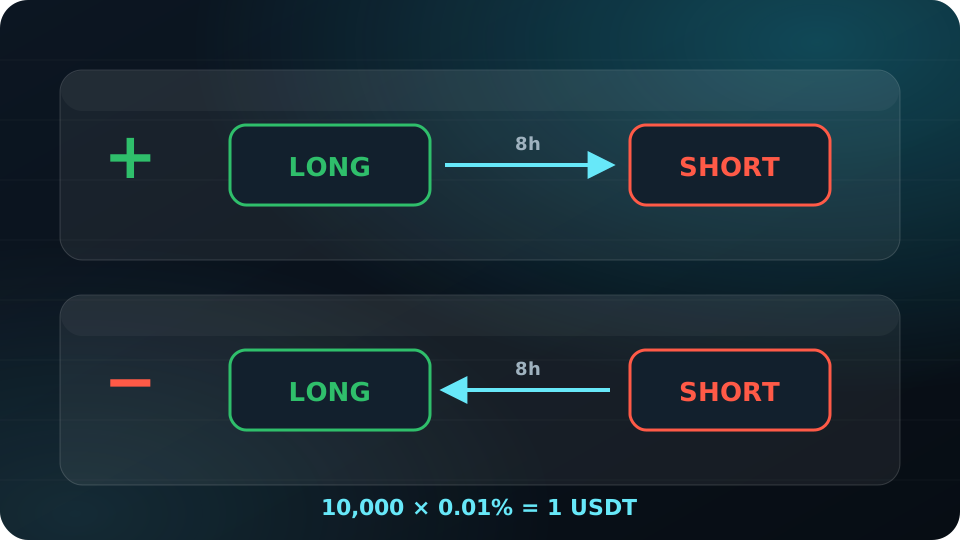
When the perpetual trades above spot, the funding rate turns positive and longs pay shorts. When it trades below spot, the rate turns negative and shorts pay longs. The payment passes between traders; it is not a fee the exchange keeps.
On Binance USDⓈ-M perpetuals, funding is exchanged every 8 hours by default, at 00:00, 08:00 and 16:00 UTC, and some contracts switch to shorter intervals in volatile markets. Other exchanges and contracts use 1, 4 or 8 hours, so check the contract details before you trade.
Working out the cost
The payment is the position's notional value times the funding rate. Margin and leverage do not change it: a 10,000 USDT position pays the same whether you posted 10,000 or 1,000 of margin.
Illustrative example: a 10,000 USDT long held while funding stays at +0.01% per 8 hours.
- Per interval: 10,000 × 0.01% = 1 USDT
- Per day, three intervals: 3 USDT
- Per 30 days: 90 USDT, which is 0.9% of the position or 9% of a 1,000 USDT margin at 10× leverage
Reading the rate
0.01% per 8 hours is a common baseline: on Binance the default interest-rate component alone is 0.03% a day. When funding climbs well above that, the long side is crowded and paying up to stay in. Deeply negative funding means the opposite.
Extreme funding often shows up near short-term tops and bottoms, because crowded positions are the ones that get squeezed. It is a sentiment reading, not a timing signal.
Practical rules
- Count funding as part of the trade's cost, next to fees, before you open a position you plan to hold for days.
- Funding is charged on notional, so high leverage magnifies it as a share of your margin.
- Spot has no funding. For holds of weeks or months, spot can be cheaper than a perpetual.
For education only, not financial advice. Trading with leverage or futures can lose more than your margin. All examples are illustrative.
Get the next guide in your inbox
One practical email a week. Free, unsubscribe anytime.
Or follow Tradevo on TelegramMarket now
Latest news