Fed Repo Bounds at 3.75%-4% and Crypto Position Size
On this page04
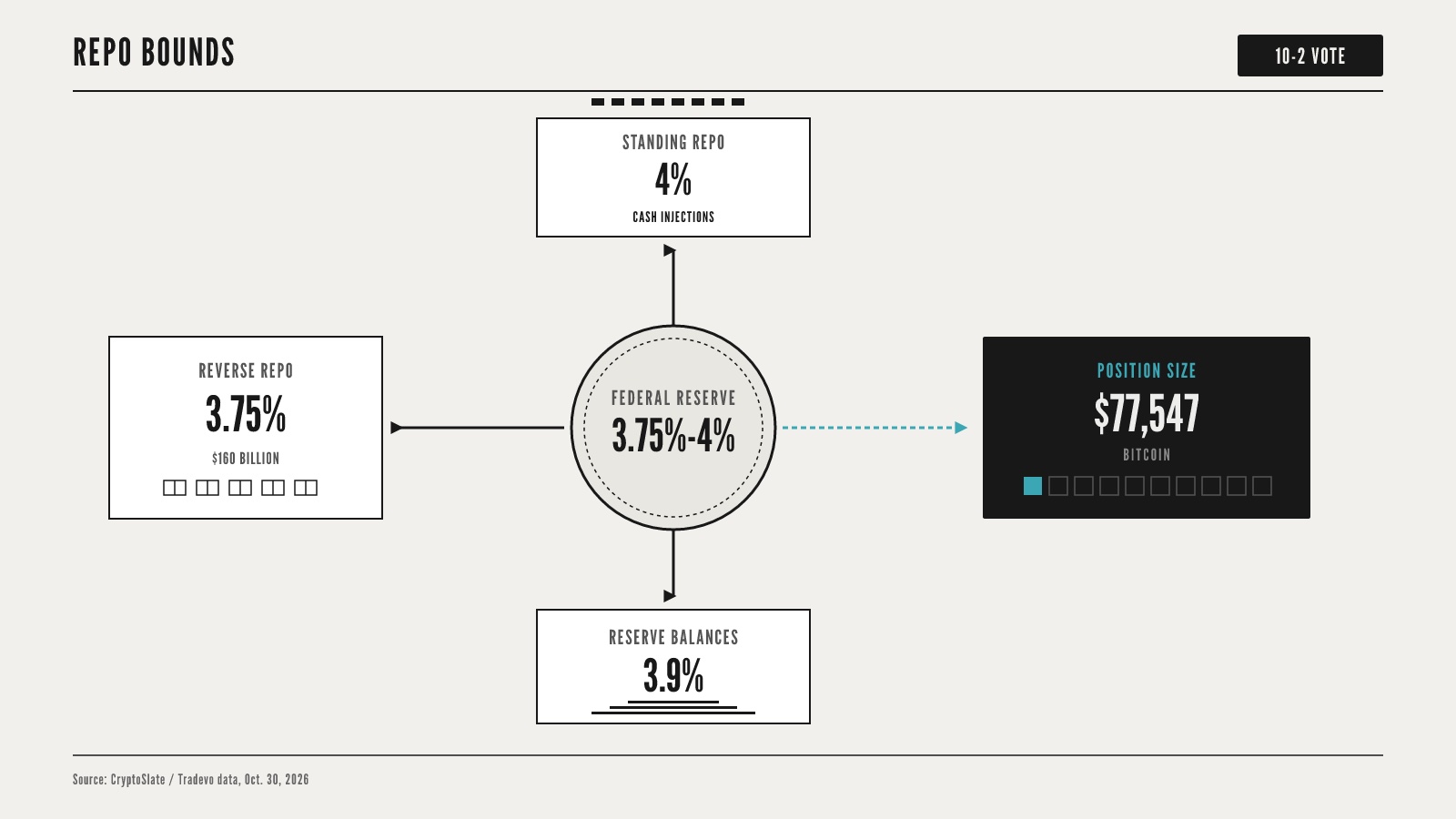
On Oct. 28, the Federal Reserve voted 10-2 to hold the federal funds target range at 3.75%-4%, while keeping the standing overnight repo rate at 4%. With Bitcoin closing at $77,547 on Oct. 30, this review examines how central bank money-market parameters influence stop placement and trading exposure.
The FOMC rate freeze and administered liquidity bounds
The Federal Open Market Committee maintained its benchmark corridor by a 10-2 vote, according to CryptoSlate. Dissenting policymakers Lisa D. Cook and Beth M. Hammack preferred a quarter-percentage-point increase in the benchmark rate. Alongside the rate freeze, the central bank issued operating instructions effective Oct. 29 that set the interest rate paid on reserve balances at 3.9%.
The operational framework also fixed the standing overnight repo rate at 4% to supply short-term secured cash injections, while the overnight reverse repo facility was set at 3.75%. To control capacity, the central bank maintained an individual counterparty cap of $160 billion per day on reverse repo operations. The directive authorized the trading desk to buy Treasury bills as appropriate to maintain ample bank reserves, while permitting purchases of alternative Treasury securities with remaining maturity up to three years. The desk was also instructed to roll over maturing Treasury principal at primary auction and reinvest maturing agency principal into Treasury bills. Notably, CryptoSlate reported that the notice set administered corridor rates without establishing an explicit quantitative purchase quota.
The numbers in context
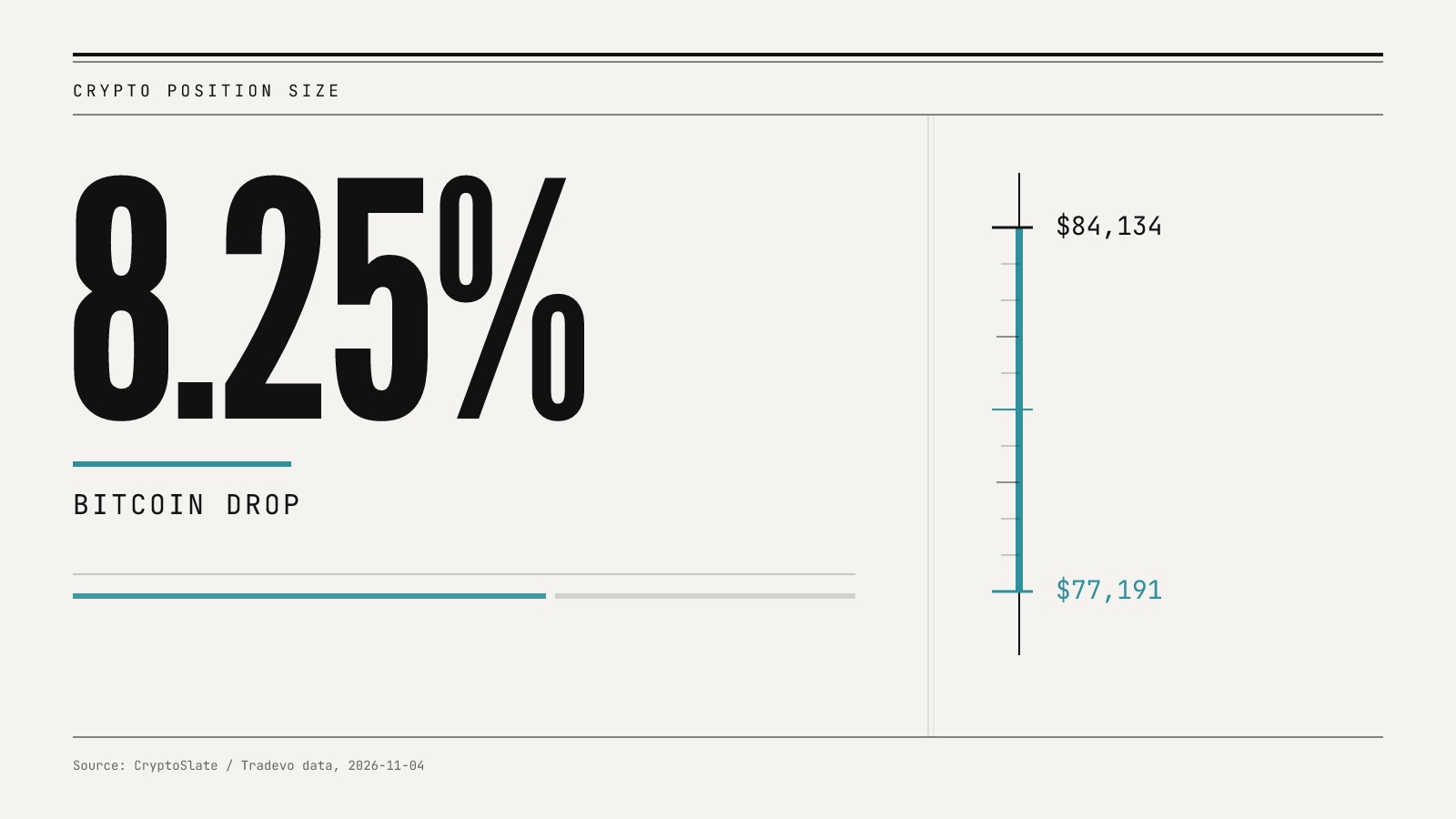
Tradevo tracks daily closing prices to measure structural trends against monetary policy shifts. As of 2026-10-30, Bitcoin's position reflects softening momentum below intermediate benchmarks.
- Bitcoin last close: $77,547 (Bybit daily closes).
- 7-day change: down 4.5%.
- 30-day change: down 7.3%.
- 90-day change: up 22.0%.
- 90-day high: $86,616 on 2026-09-21, with price below it by 10.5%.
- 90-day low: $62,901 on 2026-08-16, with price above it by 23.3%.
- Position in 90-day range: 62% of the way from the 90-day low to the 90-day high.
- 50-day simple moving average: $81,956, with price below it by 5.4%.
- Fed corridor parameters: target range 3.75%-4%, repo facility 4%, reverse repo 3.75%, reserve interest 3.9%.
Bitcoin sits 62% of the way from its 90-day low to its 90-day high. However, the price is below its 50-day average by 5.4%, following declines over both the 7-day and 30-day windows.
How Fed repo bounds impact crypto position size
In systematic trading, crypto position size is determined by total portfolio risk divided by the distance to the stop, not by personal conviction. When benchmark rates sit at 3.75%-4% and money-market rules limit reserve expansion through operational caps, market liquidity does not expand automatically.
Trading below the 50-day average of $81,956 signals that price action lacks upward momentum. In this environment, technical levels can fail more frequently, requiring wider invalidation points. For example, placing an invalidation stop further away from the entry level increases the dollar risk per coin. Because a disciplined trade plan caps total capital at risk per trade, a wider stop distance automatically dictates a smaller position size.
Traders who increase exposure because the Fed chose not to raise rates violate sound risk rules. Even with two dissents favoring a rate increase, the steady corridor does not ensure dollar inflows into digital assets. Position sizing must stay anchored to price volatility and chart structure rather than policy assumptions.
Monitoring market liquidity flows over policy bounds
A critical distinction highlighted by CryptoSlate is that implementation terms establish operational parameters rather than actual executed money-market clearing rates. While the repo facility stands ready at 4% and the reverse repo cap remains at $160 billion per day, these boundaries merely define the box within which liquidity moves.
Assessing the real effect on Bitcoin requires monitoring actual market liquidity flows rather than stated central bank policy bounds alone. If reserve management purchases of Treasury bills fail to generate net cash expansion, crypto markets may remain constrained beneath overhead technical levels.
Sources
- CryptoSlate · October 29, 2026
Written with AI assistance from the reports named above. Figures, quotes and sources are checked automatically before publishing.
For education only, not financial advice. Trading with leverage or futures can lose more than your margin. All examples are illustrative.
Get the next guide in your inbox
One practical email a week. Free, unsubscribe anytime.
Or follow Tradevo on TelegramMarket now
Latest news