Real Yields Drop 16 bps: Crypto Position Size
On this page04
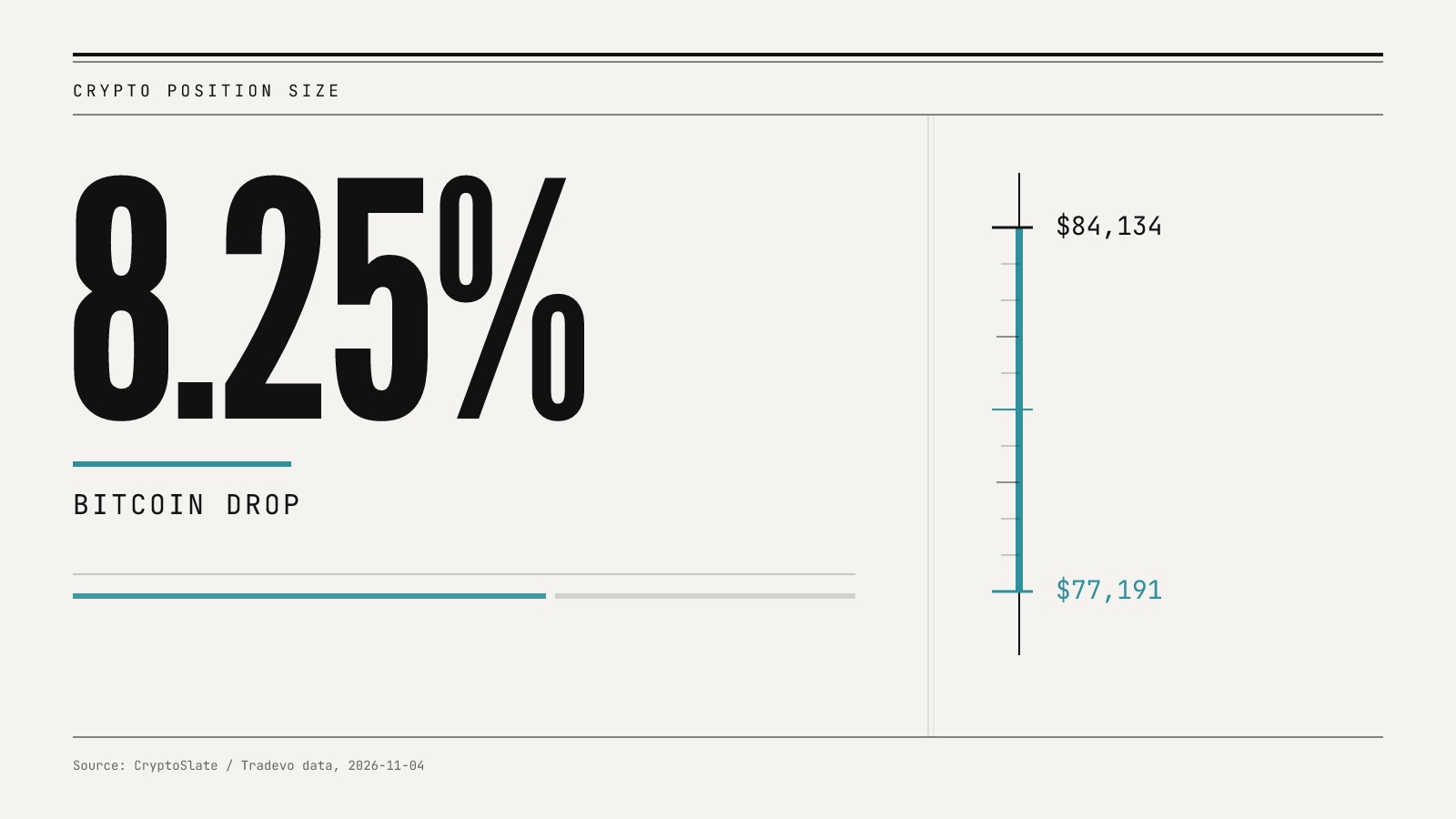
Bitcoin fell 8.25% between Oct. 21 and Oct. 30 while 10-year inflation-protected US Treasury yields declined 16 basis points. Rather than tracking lower real yields, the market followed equity weakness and heavy spot fund redemptions. This breakdown in macro correlation requires traders to review invalidation levels and risk exposure.
Yield decline fails to lift spot markets
Between Oct. 21 and Oct. 30, Bitcoin dropped from about $84,134 to $77,191, according to CryptoSlate. Over the identical timeframe, 10-year inflation-protected US Treasury yields slipped from 2.76% to 2.60%, marking a 16 basis point drop. A drop in real yields usually acts as a macro tailwind for non-yielding assets, but spot demand did not materialize.
Equity markets pulled lower at the same time. CryptoSlate reported that the Nasdaq-100 index fell 4.82% during the Oct. 21 to Oct. 30 window. Equity selling extended further when tech shares lost an extra 1.39% on Nov. 2, while Bitcoin dropped 1.34% on Coinbase to approximately $77,062. Bitfinex noted that falling tech equities and soft spot market demand overwhelmed the typical tailwind from declining real Treasury yields.
Institutional fund flows reflected that softness. CryptoSlate reported that spot Bitcoin ETF redemptions reached $643.2 million on Oct. 30. Investors then pulled a net $398.6 million from American spot Bitcoin exchange-traded funds on Nov. 2, pushing two-session net withdrawals to roughly $1.04 billion. On Nov. 2, the BlackRock iShares Bitcoin Trust recorded $405.3 million in redemptions, offset only slightly by $6.7 million in inflows into Fidelity FBTC.
The numbers in context
Tradevo records daily closing prices from Bybit to measure short-term and medium-term performance against established trend markers.
- Last close (as of 2026-11-04): $76,284.
- 7-day performance: down 6.2%.
- 30-day performance: down 11.1%.
- 90-day performance: up 17.5%.
- 50-day average: $81,975 (daily close is below it by 6.9%).
- 90-day range: 56% of the way from the 90-day low to the 90-day high.
- 90-day high: close of $86,616 on 2026-09-21 (current close is below it by 11.9%).
- 90-day low: close of $62,901 on 2026-08-16 (current close is above it by 21.3%).
Crypto position size when macro signals fail
Crypto position size defines the cash amount or coin quantity allocated to an individual trade based on account equity and stop-loss distance. When macro relationships decouple and Bitcoin drops alongside equities despite lower Treasury yields, risk parameters must adjust to wider price swings. Traders manage exposure by calculating the gap between entry and exit points rather than assuming traditional correlations will hold.
A core rule of disciplined execution is that position size follows the distance to the stop, not conviction. When Bitcoin trades below its 50-day average of $81,975 and exhibits a 30-day decline of 11.1%, volatility expands the required distance to technical invalidation. If a stop-loss must sit several thousand dollars away, the nominal trade size must shrink to preserve a constant risk cap, such as 1% of total capital.
Traders should never increase trade size to front-run an anticipated rebound from macro divergence. Market participants who assumed a 16 basis point drop in real yields would automatically lift spot prices took unnecessary drawdown when roughly $1.04 billion exited spot funds across two sessions. Capital protection relies on keeping dollar risk fixed across every setup.
Key levels and invalidation boundaries
Bitcoin traded near $76,861 early Tuesday, remaining under the $80,000 threshold. Trading firm Wintermute marked $80,000 as the critical level Bitcoin needs to reclaim to reverse its cautious outlook.
On the downside, Wintermute highlighted the 50-week moving indicator around $76,800 as key downside support for Bitcoin, warning that falling below it would worsen market risks. With the Bybit daily close recorded at $76,284, the asset has tested this region. Setting invalidation stops below confirmed weekly structural support keeps capital intact if selling extends toward the 90-day low close of $62,901.
Sources
- CryptoSlate · November 3, 2026
Written with AI assistance from the reports named above. Figures, quotes and sources are checked automatically before publishing.
For education only, not financial advice. Trading with leverage or futures can lose more than your margin. All examples are illustrative.
Get the next guide in your inbox
One practical email a week. Free, unsubscribe anytime.
Or follow Tradevo on TelegramMarket now
Latest news