BOJ ETF Sales to 860B Yen and Crypto Position Size
Auf dieser Seite05
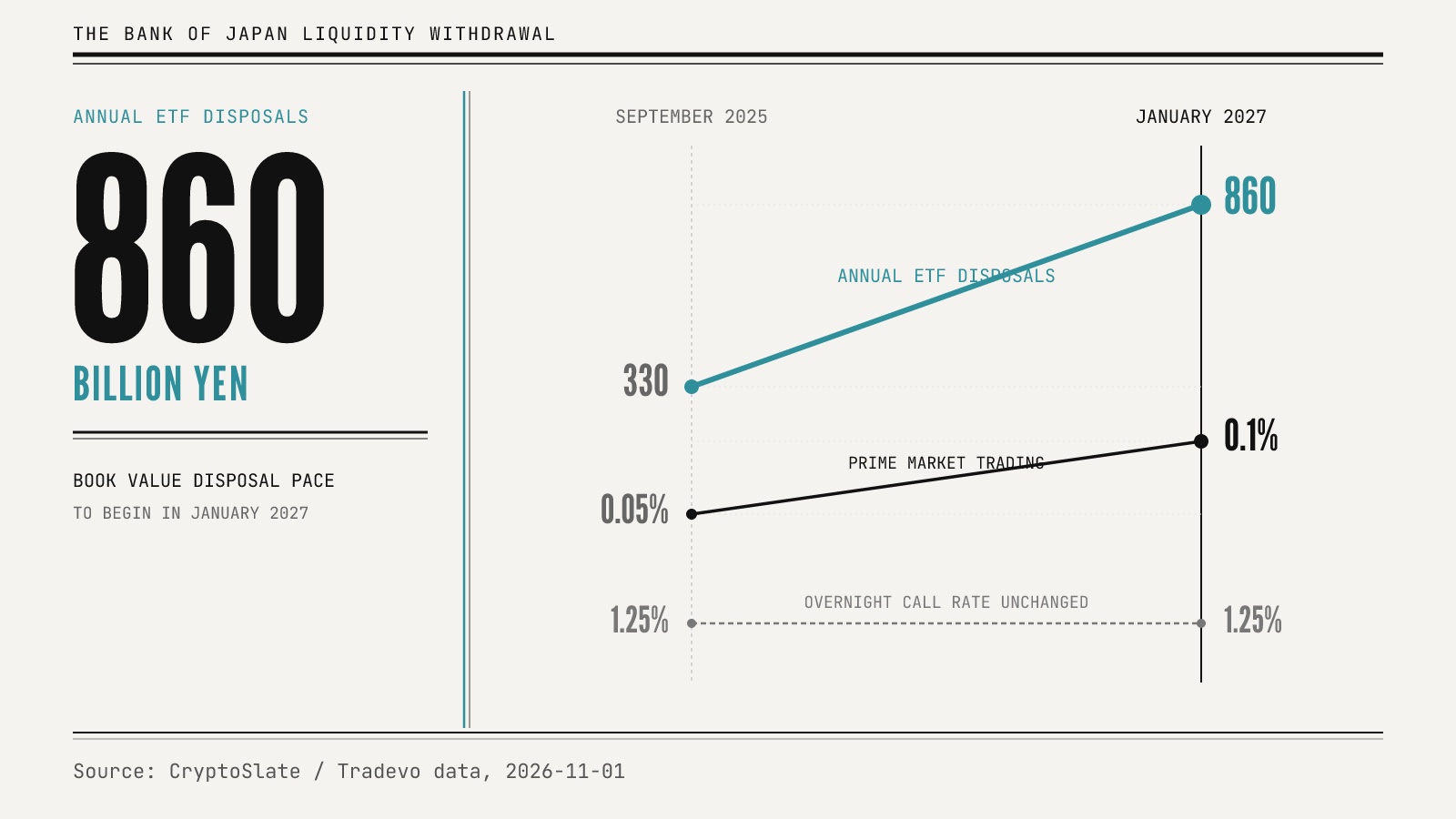
The Bank of Japan decided on October 30 to increase annual ETF disposals from about 330 billion yen to 860 billion yen at book value, as reported by CryptoSlate. At indicative market values, the central bank projected annual sales at roughly 2,460 billion yen. This analysis reviews the liquidity transmission channel and shows how widening market stress alters crypto position size.
The Bank of Japan liquidity withdrawal
According to CryptoSlate, the Bank of Japan resolved on October 30 to accelerate its balance sheet unwinding by raising annual ETF disposals to 860 billion yen at book value, up from about 330 billion yen previously. The central bank scheduled the accelerated pace to begin in January 2027. Under indicative market valuations, the revised program represents roughly 2,460 billion yen in annual equity sales.
The target disposal volume increases to approximately 0.1% of trading on the Tokyo Stock Exchange Prime Market, doubling the earlier pace of roughly 0.05% established in September 2025. Meanwhile, the policy meeting maintained Japan's overnight call rate guideline around 1.25%, leaving short-term borrowing costs unchanged. The central bank retained formal authority to temporarily adjust or suspend equity sales as financial conditions evolve.
The numbers in context
Tradevo tracks closing prices across fixed lookback windows to quantify market trends before setting trade risk. Daily closes on Bybit provide the baseline for Bitcoin as central bank balance sheet decisions unfold:
- Last close: $77,731
- 7-day change: down 3.0%
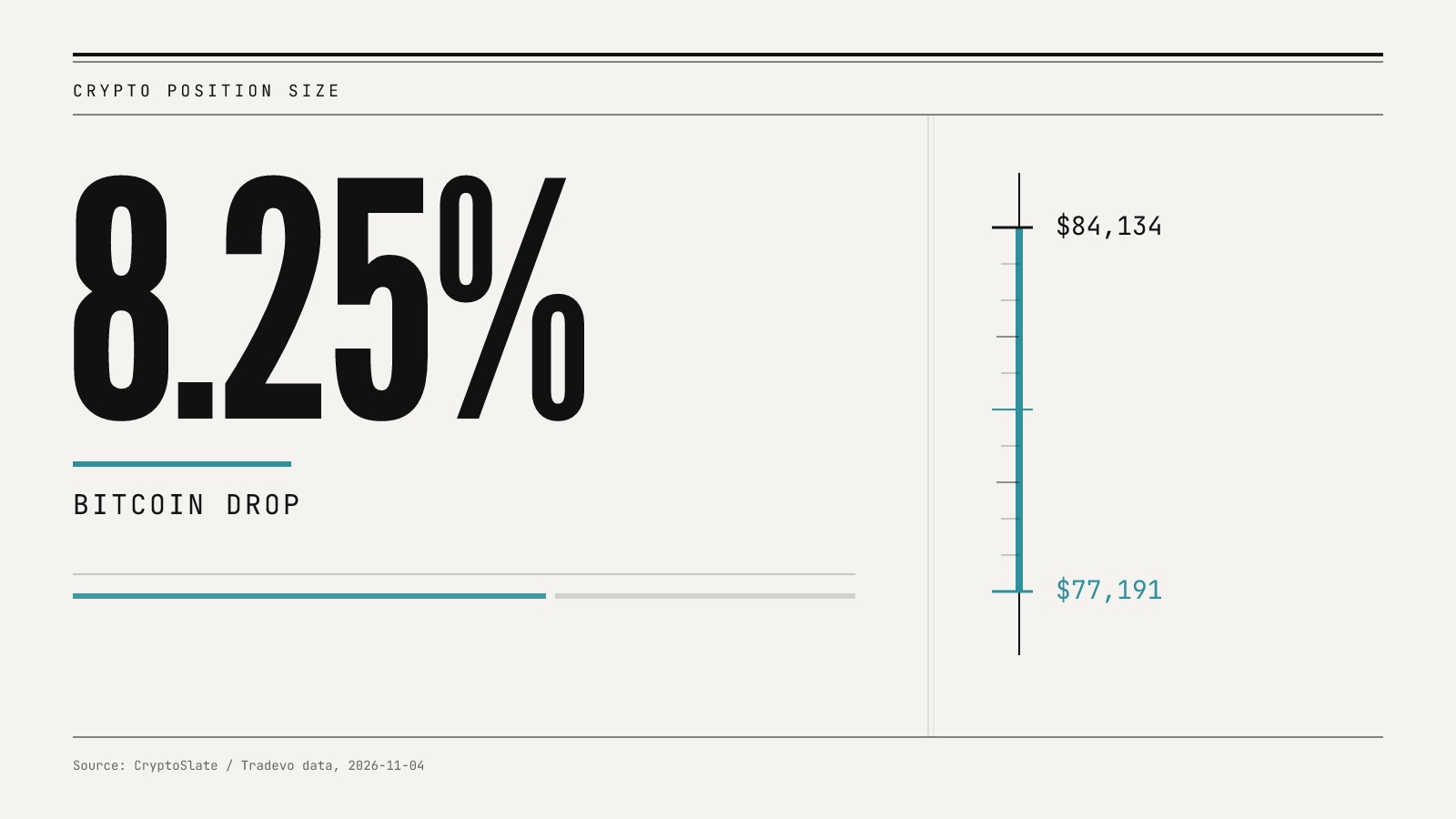
- 30-day change: down 8.0%
- 90-day change: up 21.3%
- 90-day high: $86,616 on 2026-09-21 (current price is below it by 10.3%)
- 90-day low: $62,901 on 2026-08-16 (current price is above it by 23.6%)
- Position in 90-day range: 63% of the way from the 90-day low to the 90-day high
- 50-day simple moving average: $81,966 (current price is below it by 5.2%)
- Bank of Japan annual ETF disposal target: 860 billion yen at book value (roughly 2,460 billion yen at market value)
- Japan overnight call rate guideline: around 1.25%
Bitcoin trades below its 50-day moving average of $81,966 by 5.2%, while remaining 63% of the way between the 90-day low of $62,901 and the 90-day high of $86,616. A market trading below its intermediate moving average demands strict attention to capital protection.
How cross-market deleveraging spills into crypto
CryptoSlate reported that cross-market deleveraging during August 2024 demonstrated how rapid yen moves and equity shocks triggered collateral calls that spilled directly into digital assets. When central banks withdraw market support, institutional balance sheets experience cross-asset friction.
Leveraged participants who face tighter portfolio constraints or sudden equity margin demands frequently liquidate liquid, non-equity assets to satisfy collateral requirements. Under such conditions, pressure transmits indirectly into Bitcoin order books regardless of digital asset fundamentals. Traders who fail to account for external liquidity contractions risk being caught by sudden volatility spikes.
Managing crypto position size under liquidity stress
Crypto position size represents the total capital allocated to a specific trade, determined strictly by account risk parameters and the distance between entry and invalidation. In systematic trading, position size follows the distance to the stop loss rather than personal conviction about macroeconomic outcomes.
When macro liquidity tightens, volatility expands and market spreads widen. If market structure dictates a wider stop loss to sit beyond key technical levels, position size must decrease proportionally so total currency risk remains constant. A trader should never widen their stop without reducing volume, nor increase position size because a macro narrative appears compelling.
With Bitcoin down 8.0% over 30 days and trading below the 50-day average, volatility can retest the lower bounds of the range. Keeping fixed dollar risk per trade ensures that sudden cross-market liquidations cannot damage a portfolio beyond planned thresholds.
The next milestones to watch
Traders should monitor whether the Bank of Japan exercises its formal authority to adjust or pause equity sales before the scheduled January 2027 start date. Any shift in Japan's overnight call rate guideline from around 1.25% will provide an early indicator of further cross-market collateral strain.
Quellen
- CryptoSlate · 30. Oktober 2026
Mit KI-Unterstützung auf Grundlage der oben genannten Medien verfasst. Zahlen, Zitate und Quellen werden vor der Veröffentlichung automatisch geprüft.
Nur zu Bildungszwecken, keine Finanzberatung. Beim Trading mit Hebel oder Futures kannst du mehr als deine Margin verlieren. Alle Beispiele dienen nur der Veranschaulichung.
Den nächsten Ratgeber per E-Mail erhalten
Eine praktische E-Mail pro Woche. Kostenlos, jederzeit kündbar.
Oder folge Tradevo auf TelegramMarkt aktuell
Neueste Nachrichten